
Neck pain and stress: why your neck tenses up in front of screens
Understanding neck tension to help relieve it and prevent it from coming back.
A stiff neck at the end of the day, tight upper trapezius muscles, a feeling of heaviness across the shoulders, headaches, or the sensation that your neck needs to be “unlocked”… Neck pain has become one of the most common reasons people seek treatment, especially among those who spend long hours working on a computer or looking at their smartphone.
Neck pain is often blamed on “poor posture”. However, the reality is much more complex. Head position, screen height or desk setup can certainly play a role. But in many cases, neck pain develops because several factors come together: prolonged sitting, stress, fatigue, insufficient recovery, shallow breathing, emotional tension, poor sleep or low levels of physical activity.
At Aliantis, we like to remind our patients of one simple idea: your neck is not fragile. It is designed to move. But like every part of the body, it can become painful when it is asked to do the same thing for too long without enough variety, recovery or appropriate movement.
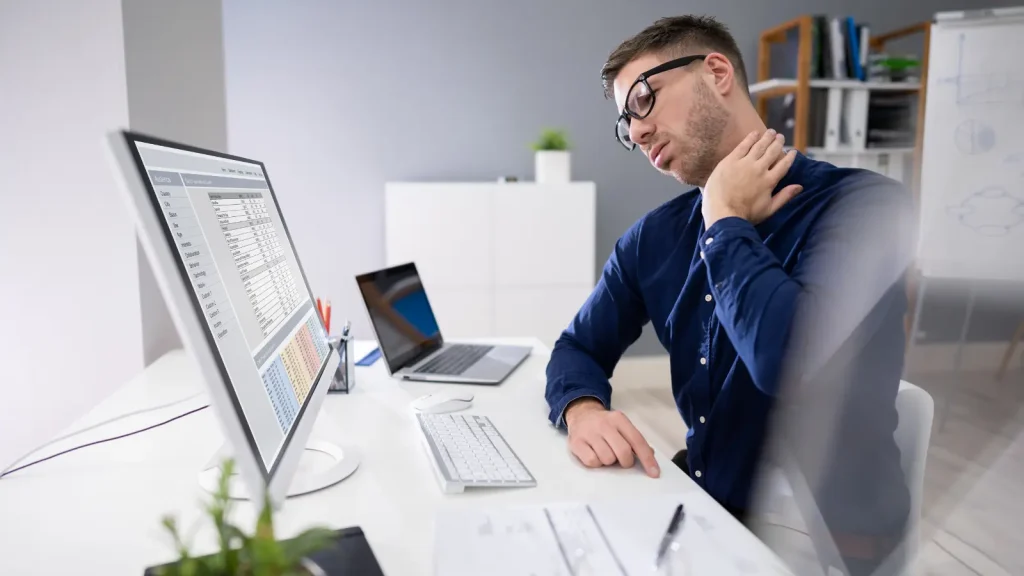
Why does your neck hurt after a day in front of a screen?
When working at a computer, the problem is not simply “sitting incorrectly”. More often, the real issue is staying in the same position for long periods with very little variation.
During an online meeting, an intense work session or a day of remote work, your head barely moves. Your eyes remain fixed on the screen. Your shoulders gradually rise. Your jaw may tighten. Your breathing becomes shallower. And without realising it, your body enters a quiet state of alert.
After several hours, the muscles of your neck, shoulders and upper back may begin to feel stiff or tired. This does not necessarily mean that you have injured yourself. More often, it is simply a sign that the area needs change: stand up, walk, breathe, move your shoulders, turn your head or relax your jaw.
The body usually tolerates an imperfect posture very well when it is temporary. What it tolerates much less well is a lack of movement.
💡 Did you know?
Even a “perfect posture” can become uncomfortable if you stay in it for too long. On the other hand, a less-than-perfect posture that changes regularly is often much better tolerated. For your neck—as for your back—the best posture is usually… the next one.
Can stress really cause neck pain?
Yes, stress can contribute to neck pain. This does not mean that “it is all in your head”. It means that the nervous system, muscles, breathing, sleep and emotions all interact with one another.
When we are stressed, the body prepares for action. Muscle tone increases. The shoulders may rise. Breathing becomes shallower and more chest-dominant. Some people clench their teeth or tighten their jaw. Others feel constant tension in the upper trapezius muscles.
For a few minutes, this response is completely normal. But when it continues for days or weeks, it can become exhausting. The body recovers less effectively, muscles may become more sensitive, and neck pain that might otherwise have settled quickly can persist.
Stress can also influence how pain is perceived. When we sleep poorly, experience a high mental load or go through a difficult period, the nervous system can become more reactive. Sensations that would normally be well tolerated may then feel more intense.
That is why an effective approach to neck pain is not limited to “relaxing a muscle”. Sometimes it is necessary to look at the bigger picture: how the person works, sleeps, breathes, moves, recovers and manages the demands of daily life.
Are screens bad for your neck?
Screens are not “bad” in themselves. The main issue is the way they influence our behaviour.
In front of a screen, we tend to move less. We blink less. We may push the head forward, round the shoulders, stay focused for too long and forget to take breaks. When using a smartphone, the gaze is often directed downwards, which can increase the feeling of neck tension in some people.
However, it is important not to overdramatise this. You do not need to maintain perfect posture at all times. What your body needs most is variety throughout the day.
Changing position regularly, bringing the screen closer, occasionally holding your phone at eye level, alternating between sitting and standing, walking during a phone call or doing a few gentle movements every 30 to 60 minutes: these simple strategies are often more useful than obsessing over an “ideal” posture.
💡 Common myth
“My neck hurts because my head is too far forward.”
Not necessarily. Head position can contribute to discomfort, but it does not explain everything. The amount of time spent without moving, stress, fatigue, lack of breaks and overall physical condition are often just as important, or even more so.
Should you correct your posture to get rid of neck pain?
Improving your posture can help some people, particularly if their workstation is poorly set up. For example, working for hours with a laptop positioned too low, using an uncomfortable chair or having a screen that is too far away may contribute to neck tension.
However, constantly chasing the “perfect posture” can become counterproductive. Many people end up monitoring themselves all the time: “Am I sitting up straight? Are my shoulders in the right position? Is my head too far forward?”This constant self-monitoring can actually increase muscle tension instead of reducing it.
The goal is not to lock your body into one ideal position. The goal is to give it more options.
A well-designed workstation should make movement easy. Your screen should be at a comfortable height. Your feet should rest on the floor and your forearms should be supported. But just as importantly, you should be able to stand up, stretch, adjust your chair, turn your head, breathe deeply and relax your shoulders throughout the day.
Posture is not a fixed rule. It is simply a starting point that should change throughout the day.
What can you do to relieve neck tension?
If your neck pain is related to stress or prolonged screen use, the first solutions are often simple. They should be realistic, easy to incorporate into your daily routine and adapted to your lifestyle.
The first key is movement. There is no need for complicated exercises. Gentle neck rotations, shoulder movements, light upper back mobility exercises, a short walk or a few deep breaths can already make a noticeable difference.
The second key is consistency. A two-minute break repeated several times a day is often more effective than a long stretching session once in a while. Your body responds best to regular movement throughout the day.
The third key is breathing. When your neck is tense, your breathing often becomes shallow and more chest-dominant. Taking just one minute to slow your breathing, allowing your ribs and abdomen to expand naturally, can help reduce your overall level of tension.
Finally, don’t forget about strengthening. A painful neck doesn’t only need to relax—it also needs to regain strength and resilience. Progressively strengthening the muscles of the neck, shoulders and upper back can help reduce future episodes, especially for people who spend many hours sitting.
🏃 In practice
If you work in front of a screen, don’t wait until your neck starts hurting before you move. Every 30 to 60 minutes, change something: stand up, walk, gently turn your head, take a few deep breaths, open your chest or relax your jaw. Small actions repeated throughout the day can make a surprisingly big difference.
When should you seek professional advice for neck pain?
Most episodes of neck pain are not serious and improve with time, appropriate movement and a few simple adjustments to daily life. However, some situations require prompt medical assessment.
You should seek medical attention promptly if your neck pain follows a significant injury, such as a fall or a road traffic accident. Severe or unusual pain, fever, unexplained weight loss, feeling generally unwell or significant night pain should also be assessed by a healthcare professional.
You should also watch for neurological symptoms, such as weakness in the arm or hand, significant numbness, difficulty walking, unusual clumsiness of the hands, bladder problems or pain that radiates down the arm and progressively worsens.
These symptoms do not necessarily indicate a serious condition, but they do warrant a professional assessment to determine the most appropriate management.
Osteopathy, physiotherapy and psychology: how can Aliantis help?
At Aliantis, managing neck pain always begins with a thorough assessment. Our goal is to understand your pain, your lifestyle, your work habits, your stress levels, your sleep, your medical history and your personal goals.
Osteopathy can help reduce pain, improve mobility and restore confidence in movement. Every treatment is tailored to the individual, with a strong emphasis on comfort, safety and helping you understand what is happening in your body.
Physiotherapy plays an essential role when neck pain becomes persistent or keeps coming back. It helps build a progressive rehabilitation programme including mobility exercises, strengthening of the neck and shoulders, motor control, return to activity, ergonomic advice and relapse prevention.
In some situations, addressing the psychological aspects of pain can also be beneficial. This is not because the pain is “all in your head”, but because stress, anxiety, mental overload, burnout and emotional challenges can increase the sensitivity of the nervous system and contribute to ongoing muscle tension. Psychological support can help you better understand these mechanisms, develop emotional regulation strategies and improve your relationship with pain when it becomes persistent or starts affecting your quality of life.
The purpose of a multidisciplinary approach is not to multiply appointments unnecessarily, but to provide the most appropriate care for each individual. At Aliantis, we want every patient to understand their pain, regain confidence in their body and become progressively more independent in managing their health.
Our goal is not simply to “unlock” your neck. We aim to understand why it has become painful, why symptoms return and how we can help you regain long-term control over your health.
Can neck pain be prevented from coming back?
It is not always possible to prevent neck pain completely. Like back pain, it may occur from time to time, particularly during periods of stress, fatigue or increased workload.
However, it is often possible to reduce how frequently it occurs, how intense it becomes and how much it affects your daily life.
There is rarely a single solution. Recovery usually relies on a combination of factors: moving more often, progressively strengthening your muscles, improving your workstation, taking regular breaks, getting enough sleep, managing stress and not being afraid to move your neck.
Neck pain is not always a sign that something is damaged or fragile. Sometimes, it is simply your body’s way of telling you that it needs more movement, more recovery and greater variety in your daily activities.
Conclusion
Neck pain is not always a sign of poor posture or a fragile neck. More often, it reflects a combination of factors such as lack of movement, stress and insufficient recovery. By gradually restoring mobility, strength and confidence in your neck, you can improve your comfort and reduce the impact of pain on your daily life.
Your neck doesn’t need to be perfectly aligned—it needs to move, breathe and recover.
FAQ about neck pain, stress and screens
Is it normal to have tight upper trapezius muscles?
Yes. Tight upper trapezius muscles are extremely common, especially during stressful periods or after spending long hours in front of a computer. However, if the pain is severe, persistent, radiates into your arm or is accompanied by weakness or other neurological symptoms, you should seek professional medical advice.
Can stress really cause neck pain?
Yes. Stress can increase muscle tension, alter your breathing, disturb your sleep and make your nervous system more sensitive. As a result, it can contribute to the development or persistence of neck pain, even though the pain itself is very real.
Should I avoid moving if my neck hurts?
In most cases, no. Gentle, progressive movement is usually beneficial. While sudden or very painful movements should be avoided, maintaining an appropriate level of activity generally helps recovery.
Can the right pillow cure neck pain?
A suitable pillow may improve comfort during sleep, but it is rarely enough to solve the problem on its own. If your pain is related to stress, prolonged screen use, lack of movement or muscle weakness, these factors also need to be addressed.
Are neck cracking sounds dangerous?
Occasional neck cracking without pain or neurological symptoms is usually harmless. However, repeatedly manipulating or forcefully “cracking” your own neck is not recommended, especially if it causes pain, dizziness or symptoms spreading into the arm.
How long does it take to recover from neck pain?
Recovery depends on the cause, how long the symptoms have been present and your individual situation. Many episodes of neck pain improve within a few days or weeks. If the pain becomes persistent or keeps returning, a progressive programme including movement, strengthening exercises and healthy lifestyle habits may be needed.
This blog article does not aim to generate new knowledge; it is based on the reading of scientific publications, blog articles and other texts.
Sources:
World Health Organization. WHO guidelines on physical activity and sedentary behaviour. 2020.
Bull FC et al. World Health Organization 2020 guidelines on physical activity and sedentary behaviour. British Journal of Sports Medicine, 2020.
Blanpied PR et al. Neck Pain: Revision 2017. Clinical Practice Guidelines. Journal of Orthopaedic & Sports Physical Therapy, 2017.
El-Allawy A et al. Clinical Practice Guideline: Nonspecific Neck Pain. 2025.
Jones LB et al. The influence of exercise on pain, disability and quality of life in office workers with chronic neck pain: systematic review and meta-analysis. Applied Ergonomics, 2024.
NICE Clinical Knowledge Summaries. Neck pain – non-specific: management et Neck pain – cervical radiculopathy.
Feller D et al. Red flags for potential serious pathologies in people with neck pain: a systematic review of clinical practice guidelines. 2024.