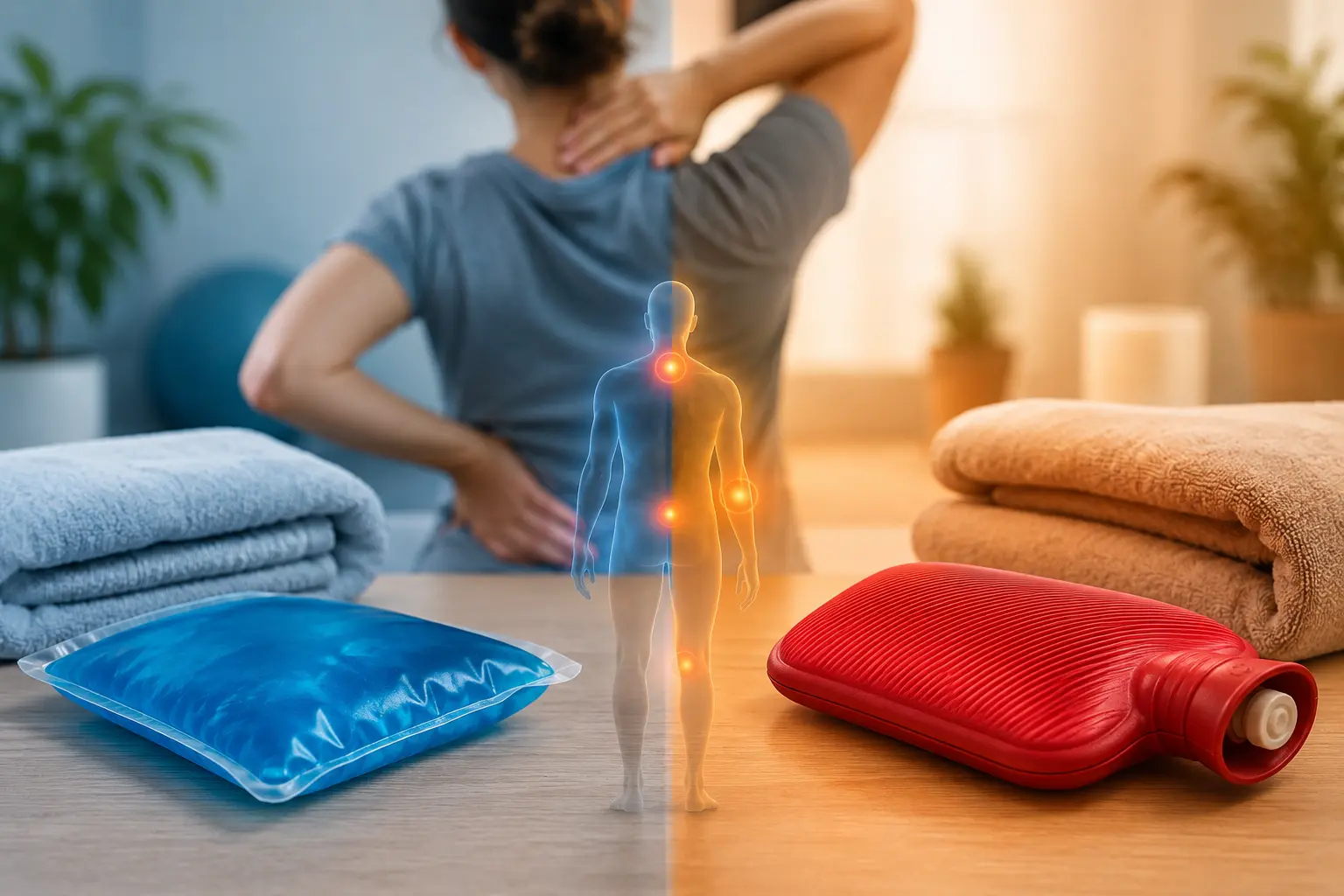
Cold or heat for pain relief? What the science really says
Ice isn’t always the best option
We’ve all done it.
After spraining an ankle, straining a muscle, waking up with neck pain or feeling sore after physical activity, our first instinct is often the same: reach for an ice pack or a hot water bottle.
And almost everyone asks the same question:
“Which one is better: cold or heat?”
For many years, the answer seemed straightforward. Ice was recommended for almost every recent injury, while heat was reserved for muscle tightness or long-lasting pain. It was an easy rule to remember and became standard practice among both healthcare professionals and athletes.
However, our understanding of pain and recovery has evolved considerably.
Today, the more useful question is not simply: “Should I use cold or heat?”. Instead, it is:
“What will help me move better and get back to my normal activities sooner?”
Because, in most musculoskeletal conditions, recovery depends far less on the temperature applied to the skin than on everything that happens afterwards.
Cold and heat relieve pain… but they don’t repair the injury
One of the most common misconceptions is that ice speeds up the healing of a sprained ligament or that heat somehow “releases” a muscle strain.
The reality is quite different.
Current scientific evidence suggests that both cold and heat mainly act on symptoms—especially pain. Many people experience relief during treatment or shortly afterwards, making everyday activities such as walking, lifting an arm or turning the neck easier.
However, this effect is usually temporary.
Neither cold nor heat directly rebuilds a ligament, repairs damaged muscle fibres or makes an injury disappear on its own.
Does that mean they are useless? Quite the opposite.
By temporarily reducing pain, they may help you regain movement sooner, return gradually to your normal activities and perform the exercises that promote recovery.
In other words, cold and heat are useful tools that can support the recovery process, but they are rarely the treatment itself.
💡 Common myth
“If my pain improves after applying ice, it means the injury has healed.”
Not necessarily.
Pain intensity and tissue healing do not always progress at the same pace.
It is possible to feel immediate relief after applying cold or heat even though the injury has not fully healed. Likewise, some people continue to experience pain even after the tissues have largely recovered.
For this reason, recovery should not be assessed solely by pain levels, but also by the gradual return of mobility, strength and the ability to perform everyday activities.
Understanding pain: much more than a tissue problem
For many years, pain was thought to be a simple reflection of the condition of the tissues. The more severe the injury, the greater the pain was expected to be.
Today, we know that this relationship does not always exist.
Research in neuroscience has shown that pain is a complex experience influenced by many factors. In addition to the condition of muscles, ligaments and joints, stress, sleep, emotions, previous experiences, beliefs about the injury and even the surrounding environment all play a role.
This is what we know as the biopsychosocial (BPS) model of pain.
This does not mean that pain is “psychological” or that the injury is not real. It means that the nervous system constantly integrates all the available information to determine how much protection the body needs at any given moment.
That is why two people with almost identical injuries can experience very different levels of pain.
Within this model, both cold and heat can help in several ways. Beyond their local physiological effects, they can also provide a sense of relief, safety and comfort that contributes to reducing pain.
And when pain decreases, it often becomes much easier to start moving again with confidence.
💡 Did you know?
Feeling less pain does not always mean that the tissues have fully healed.
Likewise, ongoing pain does not necessarily mean that significant tissue damage is still present.
In many cases, the nervous system remains more sensitive for a period of time, even while the tissues are healing normally.
That is why a thorough assessment always considers both the physical examination and each person’s individual context.
The real goal: getting you moving again
At Aliantis, we often emphasise an idea that may sound simple but has profoundly changed the way many musculoskeletal conditions are managed: movement is part of the treatment.
Years ago, people were often advised to rest almost completely for several days after a sprain, an episode of low back pain or a muscle injury. Today we know that, except in very specific situations, remaining completely inactive for too long can actually delay recovery.
That is why we talk about relative rest.
Relative rest means temporarily adapting activities that increase pain without stopping movement altogether. The goal is to find the right balance between protecting the injured area and providing the body with the stimulation it needs to recover.
In this context, cold and heat take on a much more meaningful role.
Not because they directly accelerate tissue healing, but because they may reduce pain enough to make gradual movement possible.
In other words, perhaps the most useful question is not “Which is better: cold or heat?”, but rather: “Which one helps me move a little better today?”
🏃 In practice
If applying cold allows you to walk with less pain or move your ankle more comfortably, it is probably serving its purpose.
If a hot shower makes your neck feel less stiff and allows you to perform your mobility exercises more comfortably, it is also doing its job.
In both cases, the real benefit is not the temperature itself, but what that temporary improvement allows you to do afterwards.
When can cold be useful?
If you have just suffered a sprain, a blow or a muscle strain, you have probably been told to “put ice on it as soon as possible.”
This advice has been part of routine practice for decades, and while it still makes sense in certain situations, we now know that it deserves some important nuances.
Cold can be particularly useful when the pain is recent and the area feels sensitive, inflamed or warm. Many people experience rapid pain relief during its application, allowing them to walk more comfortably, bear weight more easily or move a joint with less discomfort.
That relief may be enough to help you begin restoring movement from the very first days.
And that is probably its greatest value.
Not because ice “heals” the injury, but because it can help you return to appropriate movement sooner.
Does that mean you should always use ice?
Not necessarily.
For many years, the well-known RICE protocol (Rest, Ice, Compression and Elevation) was taught as the standard strategy after an acute injury.
Over time, research has questioned some of its principles.
Today we know that using ice as the only intervention has not been clearly shown to speed recovery from injuries such as a lateral ankle sprain. However, it can still be helpful when it forms part of a broader strategy that includes the progressive restoration of movement and function.
That is why current recommendations place much greater emphasis on combining pain relief with appropriate loading, progressive exercise and relative rest, rather than remaining completely inactive while simply waiting for time to do the work.
💡 Common myth
“If I apply ice several times a day, I’ll recover faster.”
There is no strong scientific evidence to support that idea.
Applying ice for longer periods or more frequently does not necessarily mean the injury will heal more quickly.
Its main purpose remains to relieve pain so that movement becomes easier. Once that goal has been achieved, prolonging its use usually provides little additional benefit.
Should we try to eliminate inflammation?
This is probably one of the ideas that has changed the most in recent years.
For a long time, inflammation was viewed as a harmful process that should be reduced as quickly as possible.
Today we know that reality is much more complex.
Inflammation is a normal part of the body’s response to injury. It brings the cells and signalling molecules needed to initiate tissue repair. Without this biological response, healing would be much more difficult.
This does not mean that all inflammation is beneficial or that it should be ignored when it causes significant pain or severely limits function. It simply means that the goal is no longer to “eliminate inflammation”, but to support the healing process while managing symptoms.
From this perspective, ice can be helpful because it reduces pain and improves comfort—not because it needs to “switch off” the inflammatory response completely.
💡 Did you know?
Inflammation is a natural part of the healing process.
That’s why a slightly warm or swollen area during the first few days after an injury does not necessarily mean that “something is wrong”. In many cases, it is simply part of the body’s normal response.
How should you apply ice correctly?
There’s no need for complicated techniques or prolonged ice applications.
In most cases, applying ice for 10 to 15 minutes is sufficient. Always protect the skin with a towel or cloth to reduce the risk of skin injury.
If it provides relief, you can repeat the application several times throughout the day, allowing enough time between sessions for your skin to return to its normal temperature.
The cold should feel intense but tolerable. If your skin turns completely white, becomes numb or the pain becomes severe, stop the application.
The key point is that, once the pain has eased, you should make the most of that opportunity to perform gentle movements or gradually resume the activities you have temporarily adapted.
When can heat be helpful?
While cold is often associated with recent injuries, heat is usually linked to a very different type of discomfort.
Many people notice that when they wake up in the morning or after sitting for long periods, their neck feels stiff, their back feels “locked”, or their muscles are particularly tight. In these situations, a warm shower or a heat pack often provides almost immediate relief.
That’s no coincidence.
Scientific evidence suggests that heat can temporarily reduce pain, decrease the feeling of stiffness and make movement easier in people with certain musculoskeletal conditions, such as some forms of low back pain, neck pain and osteoarthritis.
Once again, its main benefit is not repairing damaged tissues. It is creating a window of comfort that makes it easier to move.
Why does heat feel so good?
When we apply heat to a painful area, several things happen at the same time.
Heat slightly increases superficial blood flow, reduces the sensation of stiffness and, above all, changes the way the nervous system processes pain signals.
As a result, movements such as bending your back, turning your neck or getting up from a chair often become less uncomfortable.
That is why, after applying heat, it is often an ideal time to go for a short walk, perform mobility exercises or continue with your prescribed rehabilitation programme. Heat does not replace exercise—it simply helps you do it more comfortably.
💡 Common myth
“If heat relieves my pain, it means I had a muscle knot.”
Not necessarily.
The relief provided by heat does not mean that a “muscle knot” has disappeared. Much of its effect comes from changes in the way the nervous system interprets pain, together with the feeling of relaxation many people experience during heat application.
That is why heat can be beneficial even when there is no true muscle contracture.
After exercise: should you use cold or heat for sore muscles?
After an intense workout or an unfamiliar physical activity, it is common to experience muscle soreness over the following 24 to 72 hours. This is known as delayed onset muscle soreness (DOMS).
In recent years, cold-water immersion has become increasingly popular among both elite athletes and recreational exercisers. At the same time, many people still prefer a hot shower or local heat to relieve discomfort.
So, which option is better?
The answer is probably less dramatic than social media would have us believe. Scientific reviews suggest that both cold and heat can reduce the perception of post-exercise muscle soreness, although results vary depending on when they are applied, the type of activity performed and the individual.
When comparing both approaches, the differences are generally small, and there is no strong evidence showing that one is consistently superior in every situation. Therefore, if a warm shower helps you feel better and makes it easier to walk or return to training, there is no reason to assume that an ice bath would necessarily produce better results.
The most important priorities remain respecting recovery time, maintaining appropriately adapted physical activity and returning progressively to sport.
So… how do you choose between cold and heat?
After reading all this, you might be hoping for a much simpler answer. And, in reality, there is one.
If the pain has just started after a sprain, impact or physical strain, and the area feels warm or swollen, cold will often provide greater relief.
If, on the other hand, stiffness, muscle tightness or persistent discomfort that improves once you start moving is the main issue, heat is often the more comfortable option.
Even this rule has exceptions. Everyone responds differently, and in many situations the best choice is simply the one that helps you move again sooner, with greater confidence and comfort.
The goal is not to find a universal solution. It is to find the strategy that best suits your situation.
💡 Common myth
“You have to choose between cold and heat. One of them must be the right answer.”
Not necessarily. In many situations, both can relieve pain equally well. When there is no specific indication, personal preference is also a perfectly valid criterion.
Modern science is less concerned with declaring a winner between cold and heat than with understanding how each one can help you recover your function more effectively.
How can we help you at Aliantis?
At Aliantis, we see cold and heat as useful tools—but they are only a small part of treatment.
Our goal is to identify what is causing your pain, understand why it sometimes persists and develop a recovery plan tailored to your individual needs.
Depending on your situation, treatment may include manual therapy, therapeutic exercise, pain education, advice on relative rest, guidance for returning to physical activity and strategies to help you progressively regain the activities that matter most to you.
We also know that pain does not depend solely on the condition of your tissues. Factors such as sleep, stress, physical workload, work demands and personal concerns can all influence how pain is experienced and how quickly recovery progresses.
That is why we follow a biopsychosocial (BPS) approach, considering the whole person—not just the area that hurts.
Our goal is not for you to become dependent on an ice pack, a heating pad or any passive treatment. We want to help you better understand your body, regain confidence in movement and get back to doing what you enjoy with as much independence as possible.
Conclusion
If you’ve made it this far, you’ve probably realised that the question “cold or heat?” does not have a single answer.
Both can help relieve pain and make movement more comfortable. However, neither replaces the body’s remarkable ability to heal itself or the importance of an active recovery.
Today we know that, for most musculoskeletal conditions, recovery depends far more on how we progressively return to activity than on the temperature of the pack we place on the skin.
Cold and heat may help you take the first steps—but movement is what usually gets you to recovery.
Frequently Asked Questions about cold and heat
What’s better for a sprain: cold or heat?
Can heat make inflammation worse?
Can I alternate between cold and heat?
How long should I apply cold or heat?
If my pain disappears with cold or heat, does that mean I’m healed?
When should I seek professional advice?
This blog article does not aim to generate new knowledge; it is based on the reading of scientific publications, blog articles and other texts.
Sources:
Mirkin G. Why Ice Delays Recovery. Dr. Gabe Mirkin. Actualización del protocolo RICE (2015).
Dubois B, Esculier JF. Soft-tissue injuries simply need PEACE and LOVE. British Journal of Sports Medicine. 2020;54(2):72-73.
National Institute for Health and Care Excellence (NICE). Sprains and strains. Clinical Knowledge Summaries.
Martin RL, et al. Clinical Practice Guideline: Lateral Ankle Ligament Sprains. Journal of Orthopaedic & Sports Physical Therapy (JOSPT).
French Society of Rheumatology. Recommandations pour la prise en charge de l’arthrose du genou.
French SD, et al. Superficial heat or cold for low back pain. Cochrane Database of Systematic Reviews.
Wang Y, et al. Heat and cold therapy reduce delayed onset muscle soreness: systematic review and meta-analysis. Journal of Rehabilitation Medicine. 2021.
Machado AFP, et al. Effects of cooling and heating therapies on recovery after exercise: umbrella review.Sports Medicine. 2022.
International Association for the Study of Pain (IASP). Understanding Pain.
Caneiro JP, O’Sullivan P, et al. Publicaciones sobre educación en dolor y modelo biopsicosocial.
World Physiotherapy. Pain Education Resources.