The psoas: the perfect culprit?
If you search for information about the psoas online, you may quickly get the impression that this muscle can explain almost any type of pain.
That it is tight.
That it is blocked.
That it needs to be stretched every day.
That it needs to be strengthened.
That it stores toxins because it sits just behind the kidney.
That it stores emotions.
That it is responsible for most low back pain.
Over time, the psoas has gone from being a muscle that most people had barely heard of to becoming the star of countless explanations about pain. Today, it seems to get blamed for almost everything.
But when one single structure appears to explain so many different problems, it is worth stopping for a moment and asking a question.
Is the psoas really the culprit… or has it simply become an overly simple explanation for a body that is far more complex?
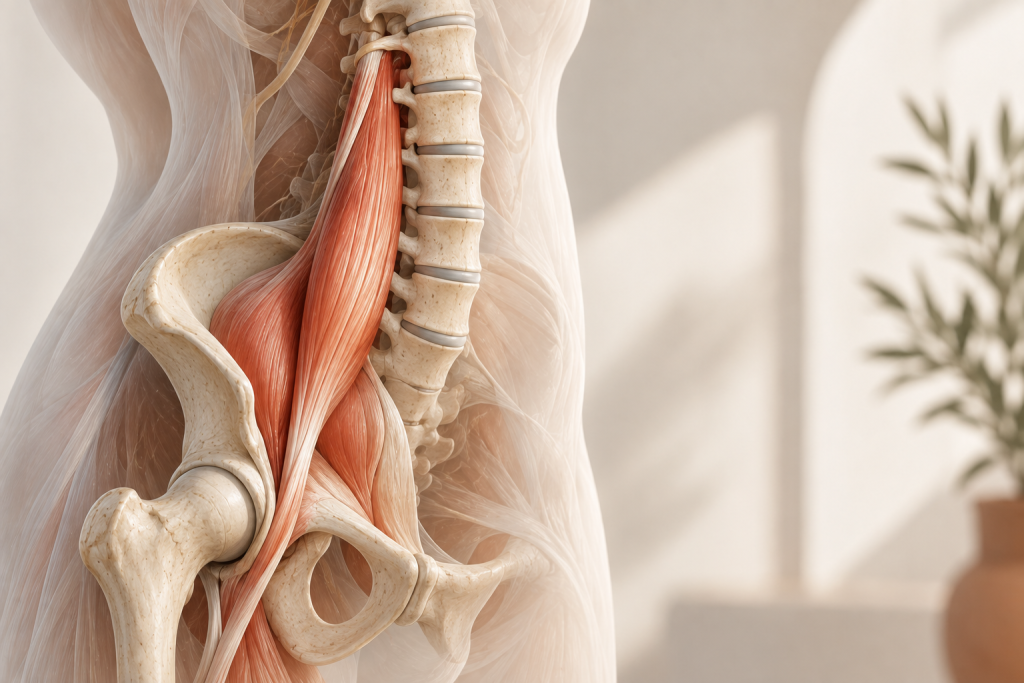
What is the psoas, really?
The psoas major is a deep muscle that originates from the lumbar vertebrae and runs down to the inner part of the femur. Together with the iliacus muscle, it forms the iliopsoas, the main flexor of the hip.
It helps us lift the leg to walk, run, climb stairs, or get in and out of a car. It also contributes to the stability of the pelvis and lumbar spine, working in coordination with the abdominal muscles, the diaphragm, the glutes, and many other muscles of the trunk and lower limbs.
In other words, it is an important muscle.
But important does not mean indispensable. And it certainly does not mean responsible for every pain.
Its location helps explain why it has become so well known. The psoas passes through one of the most anatomically complex regions of the body. It lies close to the lumbar spine, the hip joint, numerous blood vessels and nerves, the intestines, and the kidneys. When pain appears in this area, it is therefore tempting to assume that the psoas must be the problem.
However, being close to the painful area does not mean being the cause of the pain.
Imagine a busy town square. If an accident happens there, everyone present was close to the scene, but that does not automatically make them responsible. The same applies to the psoas: it is part of the “neighbourhood” where many symptoms can occur, but that does not mean it is always to blame.
The iliopsoas also never works alone. Every movement we make is the result of coordination between dozens of muscles, joints, tendons, and structures of the nervous system. The human body works like an orchestra: every instrument has an important role, but none performs the whole piece on its own.
That is why, when pain appears, there is rarely an explanation as simple as pointing to a single muscle.
💡 Did you know?
The psoas is the only muscle that directly connects the lumbar spine to the lower limbs. This strategic position means that it is involved in many everyday movements. However, its anatomical importance does not mean that it is responsible for most cases of low back or hip pain.
Why has the psoas become so famous?
The popularity of the psoas did not happen by chance.
In fact, it reflects something that often happens in healthcare: when we find a simple explanation for a complex problem, we tend to accept it easily.
If someone tells us that our low back pain is caused by one single muscle and that there is a technique to “release” it or an exercise to fix it, it is understandable that this explanation sounds appealing. It is easy to understand, reassuring, and seems to offer a quick solution.
However, the human body rarely works in such a simple way.
For a long time, medicine also looked for “the culprit”. It was assumed that behind every pain there had to be one specific structure responsible for the problem: a blocked vertebra, a damaged disc, a misaligned pelvis, or an excessively tight muscle.
Over the years, research has changed the way we understand pain.
Today we know that, especially when pain persists for weeks or months, it rarely depends on a single structure. In most cases, several factors interact at the same time: the condition of the tissues, the way the nervous system processes information, physical activity levels, sleep quality, stress, previous experiences, and even the beliefs we hold about our own body.
This does not mean that anatomy no longer matters. It means that anatomy is only one part of the story.
The psoas itself has several characteristics that make it easy to give it a starring role. It is a deep muscle, difficult to palpate, located in a region where the lumbar spine, pelvis, and hip all come together, and it is involved in many everyday movements. All of this makes it easy to turn it into the explanation for almost any discomfort in this area.
Over time, all kinds of theories began to appear. Some suggested that the psoas became shortened from spending too many hours sitting. Others claimed that it needed to be “released” through deep massage. Later came the idea that it stored toxins because it lies behind the kidney, followed by the belief that it stores emotions or stress.
Many of these theories are based on real observations. Others combine anatomical, physiological, and therapeutic concepts to create explanations that sound coherent.
But just because an explanation sounds logical does not necessarily mean it is true.
Science progresses precisely by testing these hypotheses. Some are confirmed. Others are modified. And others are eventually discarded when higher-quality studies become available.
That is exactly what has happened with the psoas.
Today, we have far more information than we did twenty years ago, and we are better able to distinguish between what we know with reasonable certainty and what still remains only a hypothesis or belief.
💡 Common myth
“If we can identify the muscle responsible for the pain, we will also find the solution.”
In reality, musculoskeletal pain rarely depends on a single structure. Understanding why someone is in pain is usually far more useful than trying to find one single culprit.
Of all the ideas that have developed around the psoas, perhaps none has spread as widely as this one: that the psoas is the body’s “dumping ground muscle” because it stores toxins and emotions.
But… is there actually any scientific evidence to support this claim?
Does the psoas really store toxins or emotions?
This is probably one of the claims that has contributed most to the popularity of the psoas.
It is common to hear that the psoas is the body’s “dumping ground muscle” because it sits just behind the kidney and therefore stores toxins that supposedly need to be removed through massage, stretching, or certain manual techniques. It is also sometimes described as the “muscle of emotions”, where stress, anxiety, or even traumatic experiences are said to become stored.
These are striking ideas and easy to remember. However, when we look at them from an anatomical and physiological point of view, they do not hold up very well.
It is true that the psoas lies very close to the kidneys. If we look at an anatomy atlas, we can see that both structures occupy the same region of the body. But proximity between two organs or tissues does not mean that one transfers substances to the other.
The kidneys continuously filter the blood. Waste products become part of the urine and are then eliminated through the urinary system. This entire process takes place within a highly organised physiological pathway.
To date, there is no scientific evidence showing that toxins leave the kidney and become stored in the psoas or in any other muscle in the body.
Likewise, there is no evidence that emotions are physically “stored” inside the psoas.
So why do so many people feel more tension in this area during periods of stress?
Because stress does affect the body.
When we experience stress, the nervous system can alter breathing, increase muscle tone, change the way we perceive pain, and make certain movements feel more uncomfortable. All of this can create a sense of stiffness or increased sensitivity in different areas of the body, including the region where the psoas is located.
But this does not mean that the muscle is storing emotions. It means that the whole body is responding to a stressful situation.
Understanding this difference matters because it completely changes how we approach the problem. If we believe the psoas is full of toxins or trapped emotions, we will try to “empty” or “release” it. But if we understand that pain depends on multiple factors — including movement, the nervous system, rest, and stress — we can focus on the things that genuinely support recovery.
💡 Did you know?
Every day, the kidneys filter around 180 litres of blood to produce approximately 1 to 2 litres of urine. The entire process of removing waste products takes place within the urinary system. There is no known mechanism by which these substances pass into the psoas and remain stored there.
🏃 In practice
If your back or hip feels tighter during a stressful period, this does not mean your psoas is “storing emotions”. Sleeping better, staying active, managing stress, and gradually returning to movement will usually have a much greater impact than trying to “release” one single muscle.
So… can the psoas actually hurt?
The answer is yes.
After discussing so many myths, it might seem as though the aim of this article is to prove that the psoas never causes problems. But that would not be true either.
Like any other muscle, tendon, or joint, the iliopsoas can become injured, irritated, or overloaded. There are well-known conditions in which this muscle plays an important role and that are part of the usual clinical assessment by doctors, physiotherapists, and osteopaths.
One of the most common is iliopsoas tendinopathy, which often causes pain at the front of the hip or in the groin, especially when lifting the knee, climbing stairs, running, or performing certain sporting movements. Iliopsoas bursitiscan also occur, although it is less common, as can snapping hip syndrome, where the tendon produces a clicking or snapping sensation as it moves over certain bony structures.
These conditions do exist, and it is important to recognise them because their treatment may differ from that of non-specific low back pain.
However, it is equally important to put them into context.
Most people who consult for low back pain do not have a psoas injury. Likewise, many cases of groin pain come from other structures, such as the hip joint itself, the adductor muscles, the abdominal wall, or even the lumbar spine.
That is why, during a clinical assessment, the question should never simply be: “Is it the psoas?”
The better question is: “Are this person’s symptoms compatible with an iliopsoas problem?”
Answering this question requires listening to the patient’s history, understanding how the symptoms began, identifying which movements increase or reduce the pain, and carrying out a full physical examination.
We sometimes use different clinical tests, such as the Thomas Test or resisted hip flexion tests. These can provide useful information, but none of them can confirm on their own that the psoas is responsible for the pain.
The same applies to imaging tests.
Finding small changes in a tendon or muscle does not necessarily mean that those changes explain the symptoms. Likewise, an apparently normal examination does not completely rule out involvement of the iliopsoas.
Diagnosis is always the result of putting all the pieces of the puzzle together.
And that is precisely what separates a high-quality clinical assessment from an overly simplistic explanation.
💡 Did you know?
Snapping hip syndrome is relatively common, especially in younger people and athletes. Many people experience this snapping sensation for years without pain or any functional limitation, so hearing or feeling a “click” in the hip does not necessarily mean there is an injury.
🏃 In practice
If the pain mainly appears when lifting the knee, getting in or out of the car, climbing stairs, or running uphill, the iliopsoas may be part of the problem. But before reaching that conclusion, it is important to assess the hip, lumbar spine, pelvis, and the way you move as a whole. Treating only the psoas without understanding the origin of the pain may mean missing the real cause of the symptoms.
Si tengo dolor lumbar… ¿es culpa del psoas?
This is probably the question that gives the whole article its meaning. And the answer is simple:
In most cases, no.
Today we know that around 90% of low back pain is classified as non-specific low back pain. This term may sound a little counterintuitive, but it does not mean that the pain is imaginary or that healthcare professionals do not know what is going on. It simply means that we cannot confidently attribute the pain to one single anatomical structure.
In other words, we cannot say with certainty that the cause is a disc, a joint, a ligament… or the psoas.
This can feel frustrating at first. We are used to thinking that every symptom must have one single cause and that, if we find it, we will also find the solution.
However, the human body does not work that way.
Imagine someone who starts running again after several years without exercising. After a few weeks, they begin to notice low back pain.
Was it the psoas?
Maybe.
Was it the lumbar muscles?
That is also possible.
Could weak gluteal muscles, a training load that increased too quickly, work-related stress, poor sleep, or spending ten hours sitting every day have played a role?
Most likely, several of these factors contributed.
That is precisely the shift in thinking that has taken place in musculoskeletal pain care over the last few decades.
Today, we understand that pain often results from the interaction between the tissues, the nervous system, and each person’s individual context.
That is why we talk about a biopsychosocial model of pain.
This does not mean that “it is all in your head”. It means that the body functions as a system in which biology, movement, lifestyle habits, and psychological factors all influence one another.
A muscle can be perfectly healthy and still become painful for a period of time. Likewise, an MRI can show significant changes in the spine of someone who feels absolutely no pain.
The relationship between imaging findings, tissues, and symptoms is not always straightforward.
That is why, when someone comes to see us with low back pain, our goal is not to desperately search for one structure to blame.
What really matters is answering other questions:
- Why did the pain appear?
- What factors are keeping it going?
- And what does this person need in order to regain confidence in movement?
When we change the questions, we also change the way we treat our patients.
Instead of trying to “fix” one specific muscle, we aim to help the body adapt better to the demands of everyday life and help the person regain the confidence to walk, run, work, carry their children, or return to the sport they enjoy.
💡 Common myth
“If it hurts where the psoas attaches, the problem must be the psoas.”
Not always. Different muscles, tendons, joints, and even structures of the nervous system can produce pain in the same area. The location of pain is only one piece of the puzzle, never a diagnosis on its own.
🏃 In practice
If you have had low back pain for several weeks, the most useful question may not be “Which muscle have I injured?”, but rather “What factors are keeping this pain going?”. In many cases, improving physical condition, gradually restoring movement, sleeping better, or reducing fear around certain activities has a much greater impact than focusing the entire treatment on one single muscle.
Should you stretch or strengthen the psoas?
If we asked ten people what to do when “the psoas is causing problems”, we would probably get two very different answers.
Some would say: “You need to stretch it because it is tight.”
Others would say exactly the opposite: “Don’t stretch it. What you need is to strengthen it.”
So… who is right?
The reality is that both answers can be correct… and both can also be wrong.
It all depends on the person in front of us.
Not every patient has the same problem, even if they use the same words to describe it. Two people may both say that they have a “tight psoas” and yet need completely different treatments.
One person may have lost a great deal of mobility after hip surgery and benefit from gradually restoring movement.
Another may have reduced their physical activity for several months and need to rebuild strength and exercise capacity.
A third person may have a problem related to training load, sporting technique, or even non-specific low back pain in which the iliopsoas is not the main structure involved at all.
And very often, treatment will include a little of everything.
That is why framing the issue as a choice between stretching and strengthening oversimplifies the situation.
The goal is not to have the most flexible or the strongest psoas possible.
The goal is for it to perform its function without causing pain, while the rest of the body is able to adapt to the demands of everyday life or sport.
Research published in recent years suggests that, in people with persistent low back pain, the best outcomes are achieved with individualised exercise programmes adapted to each patient’s needs rather than with one single type of exercise.
Depending on the situation, the programme may include:
- mobility exercises;
- strengthening;
- motor control;
- balance;
- functional training;
- sport-specific exercises to support a return to activity.
What matters is not the name of the exercise.
What matters is that it addresses the problem that person is experiencing.
At Aliantis, we try to move away from standardised treatments. We do not believe there is one universal exercise for the psoas, just as there is no single treatment that works for everyone with low back pain.
Every patient has a different story, different goals, and their own capacity for movement. Treatment should be adapted to that reality.
💡 Common myth
“Every psoas problem can be solved by stretching it.”
Not always. For some people, stretching may help reduce a feeling of stiffness. For others, strengthening or improving movement control may be far more important. And in many cases, a combination of different strategies will provide the best results.
🏃 In practice
If stretching the psoas reduces your pain and helps you move more comfortably, it may make sense to keep doing it. If a strengthening programme improves your ability to walk, run, or climb stairs without discomfort, it is also achieving its purpose. The key is not choosing between stretching and strengthening, but finding the strategy that best matches your needs.
How is psoas pain treated?
Understanding the problem
If there is one idea that sums up how musculoskeletal pain care has evolved in recent years, it is this: we have stopped treating muscles and started treating people.
This does not mean that anatomy is no longer important. Quite the opposite. It means that understanding how the body works goes far beyond identifying one structure and focusing the entire treatment on it.
When someone comes to the clinic with pain in the lower back, hip, or groin, the first step is still a complete clinical assessment.
Before thinking about the psoas, it is important to answer much more relevant questions:
- Are we really dealing with an iliopsoas problem?
- Are there any signs that suggest another condition?
- Is there anything that would justify imaging or referral to another healthcare professional?
Most of the time, a good clinical interview and physical examination provide far more useful information than an MRI performed routinely.
Staying active
Once situations that require a different type of care have been ruled out, the real treatment can begin.
And this is where the scientific evidence is especially clear.
The first goal is to help the patient understand what is happening. Knowing that pain does not always mean damage, understanding why certain movements feel uncomfortable, and recognising which factors may be influencing the symptoms can reduce uncertainty and support recovery.
The second goal is to get moving again.
This does not mean ignoring the pain or forcing yourself to do activities that make it significantly worse. It means gradually restoring the functions the body has started to avoid over time.
Sometimes that means walking more. Other times, it means returning to running.
In other cases, it may simply mean getting up from the sofa without fear, climbing stairs, or picking up a child with confidence.
Adapting exercise to each person
And to achieve this, therapeutic exercise plays a fundamental role.
But there is one idea worth remembering.
Current research is no longer trying to identify the best exercise for the psoas.
The real question is different: what is the best exercise for this person, at this stage of their recovery?
That is the difference between following a protocol and providing individualised treatment.
For some patients, rebuilding strength will be the priority. For others, improving mobility. For others, gradually increasing tolerance to effort. And in many cases, the main goal will simply be to regain confidence in a body that has been associated with pain for too long.
Manual therapy can also be part of this process.
At Aliantis, we frequently use manual techniques because they can help reduce pain, improve mobility, and make it easier for the patient to move more comfortably again.
But we see these techniques as a tool, not as the centre of treatment.
Their real value lies in helping the person regain movement, not in “releasing” a muscle or correcting a supposed structural problem.
When necessary, other options such as medication, injections, or, in very specific cases, surgery may also have a role. However, for the vast majority of iliopsoas-related problems, conservative management remains the strategy recommended by major clinical guidelines.
💡 Did you know?
The main international guidelines on low back pain agree on one very clear message: staying active and doing appropriately adapted exercise are among the interventions with the strongest scientific support. By contrast, prolonged rest tends to delay recovery and can contribute to loss of strength, confidence, and functional capacity.
🏃 In practice
At Aliantis, we do not treat a muscle. We treat a person. That is why two patients with apparently similar pain may receive different recommendations. The goal is not to follow a protocol, but to find the strategy that allows each person to regain movement and return to what matters to them.
What should we really remember?
Perhaps the biggest problem with the psoas is not the psoas itself.
Perhaps it is everything we have come to believe about it.
For years, we have looked for one structure to blame for our pain: a displaced vertebra, a damaged disc, a misaligned pelvis… and, more recently, a blocked, shortened, or toxin-filled psoas.
However, the human body rarely works in such a simple way.
The psoas is an important muscle. It is involved in many movements and can play a role in certain conditions. But turning it into a universal explanation for low back, hip, or pelvic pain does not reflect what current scientific research tells us.
Understanding this does not mean dismissing or minimising pain.
It means recognising that recovery depends on much more than one single muscle.
It depends on assessing the whole person, understanding which factors are influencing their symptoms, and building a treatment plan adapted to their needs, goals, and lifestyle.
At Aliantis, we believe this is the best way to support our patients: listening, assessing, explaining, and treating based on the best available scientific evidence.
The goal is never to treat a psoas.
The goal is to help you regain movement, confidence, and quality of life.
FAQ about the psoas
How can I tell if my pain is really coming from the psoas?
Is it bad to have a tight or shortened psoas?
Should I stretch or strengthen the psoas?
Do I need an MRI to know whether the psoas is the problem?
Can stress increase pain in the psoas region?
This blog article does not aim to generate new knowledge; it is based on the reading of scientific publications, blog articles and other texts.
Sources:
Qaseem A, Wilt TJ, McLean RM, Forciea MA. Noninvasive Treatments for Acute, Subacute, and Chronic Low Back Pain: A Clinical Practice Guideline From the American College of Physicians. Annals of Internal Medicine. 2017;166(7):514-530. DOI: 10.7326/M16-2367.
KNGF Guideline. Management of low back pain and lumbosacral radicular syndrome: the Guideline of the Royal Dutch Society for Physical Therapy (KNGF). European Journal of Physical and Rehabilitation Medicine. 2024. DOI: 10.23736/S1973-9087.24.08352-7.
Domb BG. Editorial Commentary: Iliopsoas Fractional Lengthening: Treating a Disease or a Symptom? Arthroscopy. 2019;35(6):1844-1846. DOI: 10.1016/j.arthro.2019.02.013.
Benefits and harms of exercise therapy and physical activity for low back pain: An umbrella review. Journal of Sport and Health Science. 2025. DOI: 10.1016/j.jshs.2025.101038.
A Systematic Review of Clinical Practice Guidelines for Persons With Non-specific Low Back Pain With and Without Radiculopathy: Identification of Best Evidence for Rehabilitation to Develop the WHO’s Package of Interventions for Rehabilitation. Archives of Physical Medicine and Rehabilitation. 2023. DOI: 10.1016/j.apmr.2023.02.022.
Chen Z, Wu J, Wang X, et al. Myofascial Release for Chronic Low Back Pain: A Systematic Review and Meta-Analysis. Frontiers in Medicine. 2021;8:697986. DOI: 10.3389/fmed.2021.697986.
Dowell D, Ragan KR, Jones CM, Baldwin GT, Chou R. CDC Clinical Practice Guideline for Prescribing Opioids for Pain — United States, 2022. MMWR Recommendations and Reports. 2022;71(3):1-95. DOI: 10.15585/mmwr.rr7103a1.