
Cognitive behavioural therapy: understanding how we feel to change how we act
We all interpret what happens to us through our thoughts, experiences and emotions. Sometimes, these interpretations can trigger worry, fear or sadness and lead us to adopt behaviours that, although they provide temporary relief, ultimately maintain our distress.
Cognitive behavioural therapy (CBT) is a form of psychotherapy that helps us identify these mechanisms and develop new ways of responding to difficult situations.
It is not about always thinking positively or eliminating unpleasant emotions, but about learning to relate to our thoughts, emotions and behaviours in a more flexible and adaptive way.
What is cognitive behavioural therapy (CBT)?
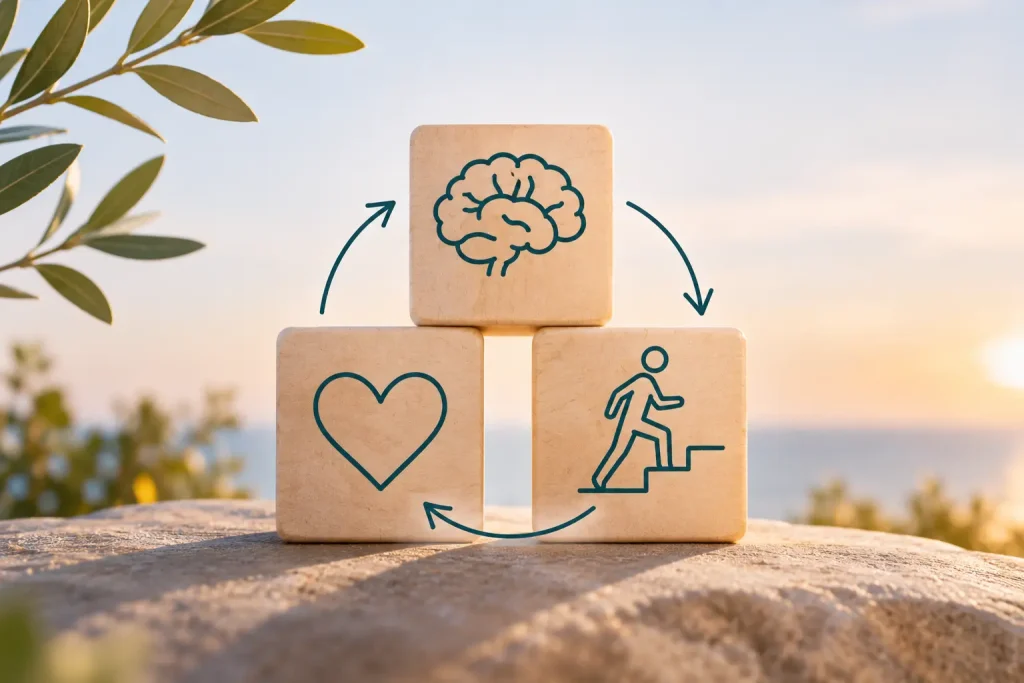
Cognitive behavioural therapy is a structured psychological approach that explores how our thoughts, emotions, physical sensations and behaviours are interconnected.
It is based on a fundamental principle: how we feel depends not only on what happens to us, but also on how we interpret and respond to those situations.
Imagine someone who has to speak in public.
Before starting, they think: “I’m going to make a mistake, and everyone will notice.”
This thought may trigger anxiety, increase their heart rate and cause muscle tension. To avoid these unpleasant sensations, the person decides not to participate.
In the short term, avoiding the situation may provide relief. However, in the long term, it can also reinforce the belief that speaking in public is dangerous or that they are incapable of doing it.
This can create a cycle that is difficult to break:
Threatening thought → anxiety → avoidance → temporary relief → persistence of fear.
CBT helps identify these patterns and gradually work towards changing them.
The goal is not to control every thought, but to learn to question unhelpful interpretations and experiment with new ways of behaving.
💡 Did you know?
Our brain constantly tries to anticipate potential threats to protect us.
However, in certain situations, it may overestimate the danger or underestimate our ability to cope with it.
As a result, a situation that poses little objective threat can trigger an intense anxiety response.
Cognitive behavioural therapy helps us reassess these interpretations and test, through real-life experiences, whether our predictions match reality.
How are thoughts, emotions and behaviours connected?
One of the central principles of CBT is that our thoughts, emotions, physical sensations and behaviours can all influence one another.
For example, imagine sending an important message and receiving no reply.
One person might think: “They must be angry with me.”
This interpretation may trigger worry, sadness or insecurity.
Another person might interpret exactly the same situation differently: “They’re probably busy and will reply when they can.”
Although the situation is identical, the emotions and responses may be different.
This does not mean that we should ignore our feelings or convince ourselves that everything is fine.
It means recognising that our interpretations are not always facts, and that learning to examine them can help us respond in a more balanced way.
Our behaviours also influence our emotions.
Constantly avoiding a situation that frightens us can maintain anxiety. In contrast, gradually facing that situation in an appropriate and manageable way can help us develop confidence and greater tolerance of uncertainty.
💡 Misconception
“Therapy is about learning to think positively.”
Not exactly.
Cognitive behavioural therapy does not aim to replace every negative thought with a positive one.
Its goal is to develop a more flexible, realistic and helpful way of thinking.
Sometimes, a situation is genuinely difficult, and feeling sadness, fear or frustration is a completely understandable response.
Therapy does not seek to eliminate these emotions, but rather to help us understand them and find ways to cope with them.
What conditions can cognitive behavioural therapy help with?
CBT is used in various areas of mental health and has strong scientific support for the treatment of certain psychological conditions.
Its main applications include anxiety disorders, depression, phobias and some stress-related difficulties.
Anxiety, excessive worrying and panic attacks
When we experience anxiety, we may develop a tendency to constantly anticipate negative situations.
Thoughts such as “What if something goes wrong?” or “I won’t be able to cope” can maintain a persistent state of alertness.
CBT helps identify these patterns, understand the physical reactions associated with anxiety and gradually reduce avoidance behaviours.
It can also be used to treat panic attacks, social anxiety and specific phobias.
Depression and loss of motivation
Depression can be accompanied by recurring negative thoughts, feelings of worthlessness, difficulty concentrating and a loss of interest in activities that were previously enjoyable.
In these situations, CBT can help identify thought patterns that contribute to emotional distress and gradually reintroduce meaningful activities.
One of the strategies used is behavioural activation, which aims to break the cycle of low mood, inactivity and social withdrawal.
The goal is not to force ourselves to feel better, but to gradually regain opportunities for participation, independence and well-being.
Stress and emotional difficulties
Stress is a natural part of our response to the demands of everyday life.
However, when perceived demands consistently exceed our available resources, we may experience difficulty relaxing, irritability, excessive worrying or exhaustion.
CBT can provide tools to recognise these mechanisms, develop coping strategies, establish healthy boundaries and improve our ability to manage challenging situations.
Insomnia and sleep problems
Worries about sleep can contribute to maintaining insomnia.
For example, repeatedly thinking “If I don’t get eight hours of sleep, tomorrow will be a disaster” can increase arousal and make falling asleep even more difficult.
Cognitive behavioural therapy specifically designed for insomnia, known as CBT-I, combines different strategies to address the factors that maintain sleep difficulties.
It is considered one of the first-line treatments for chronic insomnia.
Other psychological conditions
Specific forms of CBT are also used to treat certain obsessive-compulsive disorders, trauma-related difficulties, eating disorders and some addictive behaviours.
They may also form part of a multidisciplinary approach to managing certain persistent pain conditions.
In all these situations, it is important that the intervention is tailored to the specific condition and delivered by a suitably trained professional.
Is cognitive behavioural therapy really effective?
CBT is among the most extensively researched psychological interventions.
A large review published in JAMA Psychiatry in 2025, led by Cuijpers and colleagues, analysed 375 clinical trials involving approximately 33,000 adults.
The findings support the effectiveness of CBT for various mental health conditions, particularly certain anxiety disorders and depression. However, the magnitude of the benefits varies depending on the condition being treated and the treatment used for comparison.
Another review, published by Carpenter and colleagues in 2018, found moderate benefits of CBT compared with placebo interventions in adults with anxiety disorders.
Furthermore, some studies suggest that improvements may be maintained for several months after treatment has ended.
However, it is important to interpret these findings correctly.
The fact that a therapy is effective in clinical studies does not mean that it will work in the same way for everyone.
Progress depends on numerous factors, including the nature and severity of the condition, personal circumstances, the therapeutic relationship and how well the treatment meets the individual’s needs.
This is why individual assessment and ongoing monitoring of progress are essential.
💡 Did you know?
One of the aims of cognitive behavioural therapy is to ensure that the tools learned during treatment can continue to be used after therapy has ended.
Rather than creating a permanent dependence on the therapist, CBT aims to progressively develop the person’s independence.
Learning to recognise certain patterns and developing strategies to respond to them can also be helpful when facing future challenges.
What happens during a cognitive behavioural therapy session?
CBT typically involves a collaborative approach between the psychologist and the person seeking support.
During the initial sessions, the professional aims to understand the person’s current difficulties, how they have developed over time and how they affect everyday life.
The person’s expectations and therapeutic goals are also explored.
Based on this assessment, an individualised treatment plan is developed to meet their specific needs.
Sessions may involve a range of different strategies.
Identifying automatic thoughts
Automatic thoughts are interpretations that arise quickly, often without us being fully aware of them.
For example:
- “I always get things wrong.”
- “If I make a mistake, other people will judge me.”
- “I won’t be able to overcome this situation.”
The aim is to learn to recognise these thoughts and examine how accurately they reflect reality.
Changing behavioural patterns
Sometimes, our behaviours unintentionally contribute to maintaining a problem.
Avoiding certain situations, constantly seeking reassurance or withdrawing from important activities may provide immediate relief but make recovery more difficult.
Therapy helps identify these mechanisms and introduce gradual changes.
Learning emotional regulation techniques
Depending on individual needs, techniques such as breathing exercises, relaxation, problem-solving or strategies for managing emotionally demanding situations may be used.
These tools are not intended to eliminate all unpleasant feelings, but rather to improve our ability to respond to them.
Gradually facing challenging situations
For certain anxiety disorders, therapeutic exposure allows individuals to gradually approach situations that trigger fear.
This involves a planned and personalised process, guided by the psychologist.
The aim is to develop new learning experiences and reduce the need to avoid feared situations.
🏃♀️ In practice
Imagine someone who avoids participating in meetings because they are afraid of making mistakes in front of others.
During therapy, they may learn to identify thoughts such as “Everyone will think I’m incompetent.”
Then, together with their psychologist, they can develop small exercises to test these predictions.
For example, they might start by asking a brief question during a meeting.
Over time, these experiences can help them become more comfortable with discomfort, challenge their negative expectations and participate with greater confidence.
The aim is not to stop feeling nervous, but to be able to act even when nervousness arises.
Why are exercises recommended between therapy sessions?
One characteristic of many cognitive behavioural interventions is that therapeutic work does not end when the session finishes.
The psychologist may suggest activities to complete during the week.
These might involve observing certain thoughts, recording challenging situations, practising a strategy learned during therapy or gradually returning to an activity.
The aim is to apply what has been learned to real-life situations.
These exercises are not tests or obligations that must be completed perfectly.
They are opportunities to experiment, observe what happens and discuss the results with the psychologist.
The frequency and type of exercises should be adapted to each person’s circumstances and abilities.
💡 Common misconception
“If I don’t complete the exercises perfectly, therapy won’t work.”
False.
Therapy is not about passing tests or achieving goals perfectly.
Experiencing difficulties when applying a strategy can also provide valuable information.
The psychologist can help identify the obstacles encountered and adapt the therapeutic approach accordingly.
What matters is maintaining active participation and developing a realistic, sustainable process.
How long does cognitive behavioural therapy last?
There is no universal duration.
The number of sessions depends on the nature of the problem, its severity, how long it has been present, therapeutic goals and individual needs.
Some interventions may take place over a few weeks, while others require several months.
For example, certain CBT protocols for insomnia typically involve around 4 to 8 sessions.
For some anxiety disorders, structured programmes of approximately 12 to 20 sessions may be used, although these figures are not a rule that applies to everyone.
Throughout the process, the psychologist and the patient can review their goals, assess progress and adapt the intervention.
The duration of therapy should not be determined solely by a predetermined number of sessions, but rather by each person’s needs and progress.
Can cognitive behavioural therapy be delivered online?
Yes. Cognitive behavioural therapy can be delivered face-to-face or through different forms of remote care.
A review published in CMAJ in 2024 analysed 54 clinical trials involving more than 5,400 participants and found broadly similar outcomes between professionally guided CBT delivered by video call or telephone and face-to-face interventions.
However, this does not mean that any digital application can replace psychotherapy.
The professional’s qualifications, the quality of the intervention, confidentiality and the characteristics of the condition being treated remain essential considerations.
The choice between face-to-face and online therapy should take into account the person’s preferences and clinical needs.
Is cognitive behavioural therapy suitable for everyone?
Although cognitive behavioural therapy (CBT) has substantial scientific support, it is not necessarily the best option for every person or situation.
Different psychological approaches may be appropriate depending on the problem, personal preferences and therapeutic goals.
In some cases, combining psychotherapy with medical follow-up, medication or other interventions may be recommended.
The initial assessment helps determine which type of support may be most appropriate.
💡 Common misconception
“If I need therapy, it means I can’t manage my problems on my own.”
False.
Seeking psychological support does not mean being weak or lacking personal resources.
We can all experience situations in which our usual coping strategies are no longer sufficient.
Psychotherapy provides a professional environment in which to understand these difficulties, explore new perspectives and develop tools adapted to our individual needs.
You do not need to wait until you reach a crisis point to seek professional support.
How can cognitive behavioural therapy help you at Aliantis?
At Aliantis, our multidisciplinary clinic in Sitges, we offer personalised psychological care based on an individualised, supportive approach adapted to each person’s needs.
Our health psychologist, María Florencia Molina Vázquez, uses cognitive behavioural therapy (CBT) alongside other therapeutic approaches. CBT is supported by scientific evidence for treating a range of psychological difficulties.
Through this therapeutic approach, we can help you better understand the relationship between your thoughts, emotions and behaviours, identify the mechanisms that maintain psychological distress and develop strategies for coping with challenging situations.
The process begins with an individual assessment to explore your current difficulties, how they affect your daily life and the goals you would like to achieve.
Based on this assessment, a personalised treatment plan is developed to meet your needs. This may include cognitive behavioural strategies to address anxiety, stress, emotional difficulties or depressive symptoms, among other concerns.
At Aliantis, we recognise that mental health cannot be separated from each person’s personal, social and physical circumstances. For this reason, when appropriate, our multidisciplinary approach also allows us to consider factors related to sleep, physical activity, persistent pain and overall wellbeing.
Our aim is not simply to relieve symptoms, but to help you understand what you are experiencing, develop your own coping resources and gradually regain independence and wellbeing.
If you are looking for cognitive behavioural therapy in Sitges or need psychological support, our psychology service can help you determine which type of intervention is best suited to your situation.
Understanding our patterns to regain independence
Our thoughts, emotions and behaviours are part of a complex system that is constantly changing.
Sometimes, certain ways of interpreting or responding to situations can contribute to maintaining psychological distress.
Cognitive behavioural therapy provides tools to recognise these mechanisms, experiment with new responses and develop a more flexible relationship with our experiences.
Frequently asked questions about cognitive behavioural therapy
Is cognitive behavioural therapy effective for anxiety?
Yes. CBT is one of the most extensively researched psychological treatments for various anxiety disorders. The intervention is adapted to the type of anxiety, its severity and each person’s individual needs.
What is the difference between CBT and traditional psychotherapy?
CBT is generally characterised by a structured approach, shared therapeutic goals and the use of specific strategies to address thoughts and behaviours. However, there are different psychotherapeutic approaches, and not all therapies work in the same way.
Do I have to talk about my childhood during CBT?
Not necessarily. CBT generally focuses on current difficulties and the mechanisms that maintain them. However, past experiences may be explored when they are relevant to understanding the problem.
Can cognitive behavioural therapy help with negative thoughts?
Yes. It can help identify automatic thoughts, examine how helpful or accurate they are and develop more flexible interpretations. The aim is not to eliminate all negative thoughts or replace them with forced optimism.
How many CBT sessions will I need?
It depends on the nature and severity of the problem, as well as the therapeutic goals. Some interventions are relatively brief, while others may require several months. The number of sessions is assessed individually and can be adjusted according to progress.
Can I see a psychologist even if I don’t have a diagnosis?
Yes. You do not need a psychological diagnosis to seek professional support. Emotional difficulties, major life changes, stress or adjustment problems can also be valid reasons to consult a psychologist.
Where can I receive cognitive behavioural therapy in Sitges?
At Aliantis, our multidisciplinary clinic in Sitges, we offer personalised psychological care.
Our health psychologist, María Florencia Molina Vázquez, uses cognitive behavioural therapy as part of her therapeutic approach, adapting treatment to each person’s needs and goals.
This blog article does not aim to generate new knowledge; it is based on the reading of scientific publications, blog articles and other texts.
Sources:
Cuijpers P. et al. (2025). Revisión sistemática de la eficacia de la terapia cognitivo-conductual en adultos con trastornos mentales. JAMA Psychiatry. DOI: 10.1001/jamapsychiatry.2025.0482.
Carpenter JK. et al. (2018). Cognitive behavioral therapy for anxiety and related disorders: A meta-analysis of randomized placebo-controlled trials. Depression and Anxiety. DOI: 10.1002/da.22728.
van Dis EAM. et al. (2020). Long-term outcomes of cognitive behavioral therapy for anxiety-related disorders: A systematic review and meta-analysis. JAMA Psychiatry. DOI: 10.1001/jamapsychiatry.2019.3986.
Walter HJ. et al. (2020). Clinical practice guideline for the assessment and treatment of children and adolescents with anxiety disorders. Journal of the American Academy of Child & Adolescent Psychiatry. DOI: 10.1016/j.jaac.2020.05.005.
Zandieh S. et al. (2024). Revisión sistemática y metaanálisis sobre terapia cognitivo-conductual a distancia y presencial. Canadian Medical Association Journal. DOI: 10.1503/cmaj.230274.