
Sciatica: why does pain travel down the leg and how can you relieve it?
Understanding pain to regain movement
Do you experience pain that starts in your lower back or buttock and travels down your leg? Do you feel burning sensations, electric shocks, tingling or numbness?
You may have been told that you have sciatica or that your sciatic nerve is “pinched”. However, not all pain radiating down the leg has the same origin, and not all cases are caused by a herniated disc.
Although sciatica can be very painful, many people improve over time with appropriate conservative treatment.
Understanding which structures may be involved, how the condition is diagnosed and which strategies support recovery can help you approach the problem with greater confidence and avoid unnecessary treatments.
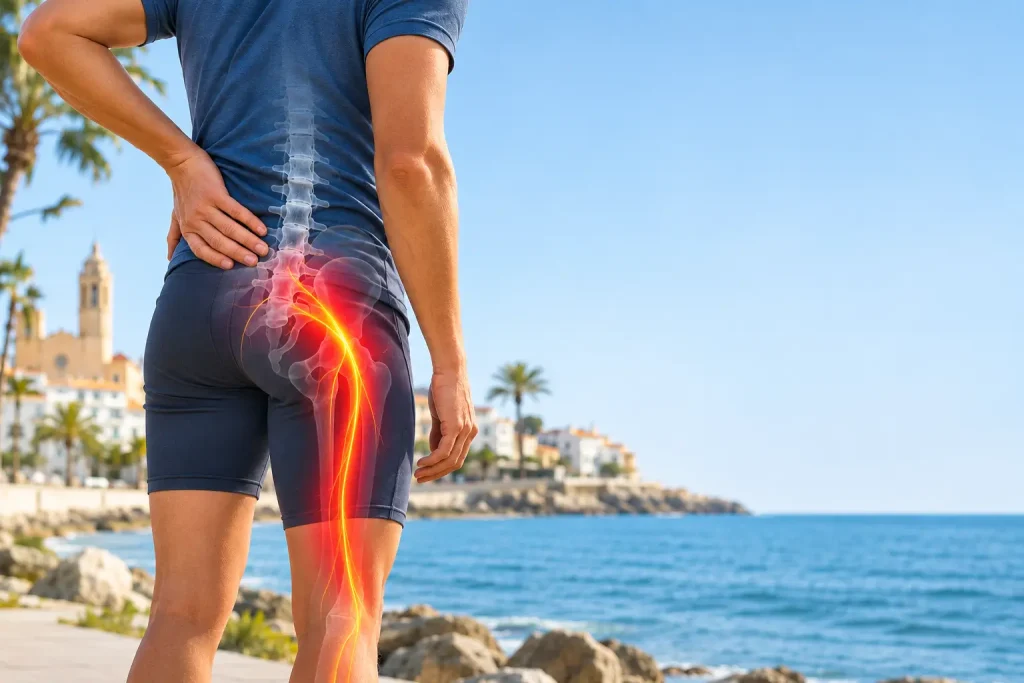
What is sciatica, and is there a difference between sciatica and sciatic pain?
The sciatic nerve is the thickest nerve in the human body. It is formed by fibres originating from the L4 to S3 nerve roots, passes through the pelvis and buttock region, and travels down the back of the thigh before dividing into its main branches.
In everyday language, the terms sciatica and sciatic pain are commonly used to describe pain that radiates from the lower back or buttock into the leg. There is no universally accepted distinction between these terms.
From a clinical perspective, it is important to distinguish between:
- Radicular pain: pain caused by abnormal activation of sensory fibres in a nerve root or its ganglion.
- Radiculopathy: impaired function of a nerve root, which may cause motor, sensory or reflex deficits, with or without pain.
- Sciatic neuropathy: damage or dysfunction affecting the sciatic nerve itself after it forms from the sacral plexus.
- Referred pain: pain perceived at a distance from its source, without necessarily involving nerve damage.
These conditions may produce similar symptoms, but they are not equivalent.
What are the most common symptoms?
Symptoms may include:
- Pain radiating from the back or buttock into the thigh, lower leg or foot.
- Burning sensations or electric shock-like pain.
- Tingling or numbness.
- Pain that increases with certain movements, coughing or sneezing.
- In some cases, muscle weakness or changes in sensation.
You do not need to experience all these symptoms to have sciatica.
💡 Did you know?
Radicular pain and radiculopathy are not exactly the same thing.
A person may experience severe radicular pain without any measurable loss of strength or sensation. Conversely, neurological impairment can also occur with relatively little pain.
What are the main causes of sciatica?
The most common cause of radicular sciatica is irritation or dysfunction of a nerve root in the lumbar spine.
However, the sciatic nerve can also be affected outside the spine, particularly in the pelvis or buttock region.
Lumbar disc herniation
Intervertebral discs are located between the vertebrae and help distribute loads and allow movement.
A herniated disc occurs when part of the disc material extends beyond its normal boundaries.
Under certain circumstances, this material can irritate a nerve root through mechanical and inflammatory mechanisms, causing pain that radiates down the leg.
The L5 and S1 nerve roots are among those most frequently affected.
However, having a herniated disc does not necessarily mean having sciatica. Disc abnormalities are also found in people without symptoms.
Lumbar spinal stenosis and foraminal narrowing
Lumbar spinal stenosis involves a narrowing of the space available for neural structures within the spinal canal.
Narrowing can also occur in the lateral recesses or intervertebral foramina, through which the nerve roots pass.
These conditions may be associated with degenerative changes affecting the discs, joints and ligaments.
When symptomatic central spinal stenosis is present, some people experience pain, heaviness or altered sensation in their legs when walking or standing, with relief when sitting or bending forward.
This presentation is known as neurogenic claudication and should not automatically be confused with sciatica caused by a herniated disc.
Deep gluteal syndrome
The sciatic nerve can also become irritated or compressed as it passes through the buttock region, outside the spine.
Deep gluteal syndrome describes a group of conditions involving nerve entrapment within this anatomical region.
The mechanisms described include abnormalities involving the piriformis muscle, the obturator internus–gemelli complex, fibrous bands and certain structures close to the hamstrings.
Symptoms may include deep buttock pain, discomfort when sitting and pain radiating down the back of the thigh or leg.
However, these symptoms are not specific. Diagnostic criteria are not fully standardised, and no single clinical test can confirm every case.
Assessment combines the patient’s medical history, neurological and hip examinations and, when indicated, additional investigations. It is important to rule out other causes before attributing symptoms to sciatic nerve entrapment.
Other less common causes
In certain circumstances, neural structures may be affected by trauma, haematomas, surgical complications or space-occupying lesions in the pelvis.
More rarely, certain conditions, such as endometriosis involving the nerves, can cause similar symptoms.
These possibilities should be considered when symptoms follow an unusual course or when signs appear that do not fit a typical musculoskeletal presentation.
💡 Common misconception
“Sciatica is always caused by a herniated disc.”
Not necessarily. Although a herniated disc is a common cause of lumbar radicular pain, other spinal and extraspinal causes also exist.
Furthermore, pain travelling down the leg may be referred pain without any involvement of the sciatic nerve.
What is incomplete sciatica?
The term incomplete sciatica is sometimes used informally to describe pain that extends into the buttock or thigh but does not travel all the way down the leg.
It is not a clearly defined diagnostic category.
Pain that stops at or above the knee does not, by itself, indicate whether a nerve is affected or where the problem is located.
What can cause pain that does not travel all the way down the leg?
Possible causes include:
- Lumbar radicular pain: an irritated nerve root can cause pain without it necessarily reaching the foot.
- Sciatic nerve involvement in the buttock region: some extraspinal neuropathies may cause symptoms limited to the buttock or thigh.
- Femoral nerve-related pain (cruralgia): pain commonly associated with upper lumbar nerve roots, particularly L2–L4, which usually affects the front of the thigh and may extend to the knee.
- Musculoskeletal referred pain: structures such as the hip, lumbar region, gluteal tendons or sacroiliac joint can produce radiating pain without nerve damage.
The location of symptoms provides useful information, but it must be interpreted alongside the patient’s medical history and clinical examination.
💡 Did you know?
The pattern of pain does not always match the anatomical nerve distribution diagrams found in textbooks.
There is variability between individuals, and different structures can produce partially overlapping pain patterns.
How is sciatica diagnosed?
Diagnosis begins with a clinical interview and physical examination.
The healthcare professional assesses where the pain begins, how it spreads, which activities affect it and whether any neurological abnormalities are present.
Clinical and neurological examination
Depending on the symptoms, the assessment may include:
- Strength testing of different muscle groups.
- Sensation in the leg and foot.
- Deep tendon reflexes.
- Lumbar spine and hip mobility.
- Walking ability and functional capacity.
- Responses to neural provocation or tension tests.
These tests include the straight leg raise test, also known as Lasègue’s test, which can help identify certain presentations of lumbar radicular pain.
When an extraspinal cause is suspected, a specific examination of the buttock region and hip may also be necessary.
No single test can confirm all causes of sciatica.
Is an MRI scan necessary?
Not always.
In recent-onset sciatica without red flags, an MRI scan is not usually required as a routine investigation.
Imaging is particularly considered when there are significant neurological deficits, suspicion of a serious underlying condition or persistent symptoms for which the results could influence treatment decisions.
Furthermore, a lumbar MRI cannot adequately assess all possible extraspinal causes. In selected cases, it may be necessary to examine other anatomical regions or carry out additional investigations.
💡 Common misconception
“I need an MRI scan to know exactly what’s wrong.”
Not necessarily.
Imaging can reveal anatomical changes that do not cause symptoms. Its usefulness depends on whether it answers a specific clinical question and helps guide treatment decisions.
How long does sciatica take to improve?
Recovery varies depending on the underlying cause, the duration of symptoms and individual circumstances.
For many people with recent-onset sciatica of radicular origin, improvement begins within the first few weeks and continues over the following months.
However, some people experience persistent symptoms and require reassessment or more specific treatment.
Recovery is not always linear. Some days may be more uncomfortable than others, with fluctuations in pain intensity.
These fluctuations do not necessarily indicate a new injury.
Can a herniated disc be reabsorbed?
Yes. Some herniated discs decrease in size over time through natural biological resorption processes.
However, not all disc herniations follow the same course, and symptoms can resolve without the herniation necessarily disappearing completely.
💡 Did you know?
Pain intensity and the size of a herniated disc do not have a direct or consistent relationship.
Inflammation, nervous system sensitivity and other individual factors can also influence the experience of pain.
What treatments can help relieve sciatica?
In the absence of red flags or neurological deficits requiring other interventions, initial treatment is usually conservative.
The aim is to reduce limitations, maintain activity and support a gradual recovery.
Staying active and avoiding prolonged rest
Complete bed rest is generally not recommended.
Whenever possible, it is advisable to continue with normal daily activities, temporarily adapting those that significantly increase symptoms.
The aim is not to ignore pain, but to find a tolerable level of activity.
Physiotherapy and therapeutic exercise
Physiotherapy can help improve function and gradually restore physical capacity.
Depending on the clinical assessment, treatment may include mobility exercises, strengthening, physical conditioning and a gradual return to everyday activities.
Neurodynamic exercises may also be used in selected patients, although their suitability and tolerance should be assessed individually.
Clinical trials investigating physiotherapy for lumbar sciatica suggest potential functional benefits, which are generally modest.
No single exercise programme has been shown to be superior for everyone.
Manual therapy and osteopathy
Manual techniques, such as joint mobilisation or certain soft tissue techniques, may be used as a complement to active treatment.
However, there is insufficient evidence to suggest that osteopathy can reposition a herniated disc, mechanically release a nerve root or resolve sciatic neuropathy on its own.
Clinical guidelines recommend incorporating manual therapy, when appropriate, into a programme that includes exercise and education.
For deep gluteal syndrome, research on conservative treatments is more limited and does not establish a universally effective treatment protocol.
Medication
In certain cases, a doctor may consider medication to help relieve symptoms.
Non-steroidal anti-inflammatory drugs (NSAIDs) may be used for a limited period in selected patients, taking into account that their specific benefit for sciatica is uncertain and that they can cause adverse effects.
NICE guidelines advise against the routine use of gabapentinoids, other antiepileptic drugs, oral corticosteroids and benzodiazepines for sciatica. They also advise against opioids for chronic sciatica.
These recommendations mainly concern sciatica of lumbar origin and should not automatically be applied to all peripheral neuropathies.
The choice and review of medication should be carried out by a medical professional.
What can I do at home if I have sciatica?
Some simple measures can help you stay active while your symptoms improve.
- Walk according to your tolerance: you can start with short walks and gradually increase their duration.
- Change position regularly: there is no single perfect posture that you need to maintain throughout the day.
- Temporarily adjust physical loads: if certain movements clearly increase radiating pain, reduce their intensity or volume and gradually reintroduce them.
- Avoid forcing stretches: a strong sensation of tightness does not necessarily mean that the nerve needs stretching. If a movement increases tingling or radiating pain, it is advisable to modify it.
- Continue with activities you can tolerate: functional recovery usually requires gradual exposure to movement rather than avoiding it indefinitely.
If new symptoms develop, particularly progressive loss of strength or sensation, seek medical assessment.
When are injections or surgery considered?
Most people with uncomplicated radicular sciatica do not need surgery.
However, certain situations may require specialist treatment.
Epidural injections
In some patients with severe acute sciatica, a specialist may consider an epidural injection of local anaesthetic and corticosteroid.
These interventions may provide short-term relief, although the benefits are generally limited and not guaranteed.
These should not be confused with injections targeting possible extraspinal nerve entrapments, for which the indications and supporting evidence differ.
Surgery for a herniated disc
Surgery may be considered when pain and functional limitations persist despite appropriate conservative treatment, and when symptoms are consistent with imaging findings.
It may also be indicated more urgently in the presence of certain neurological deficits.
In selected patients with sciatica caused by a herniated disc, surgery may provide faster relief of leg pain than non-surgical treatment.
However, differences between the two approaches often decrease over time.
The decision should take into account the clinical situation, potential risks and the patient’s preferences.
When should you be concerned about sciatica?
Although most episodes of sciatica are not medical emergencies, certain symptoms require immediate medical attention:
- New difficulty starting urination, urinary retention or loss of bladder control.
- New loss of bowel control.
- Reduced sensation in the genital area, around the anus or when wiping after using the toilet.
- Significant or rapidly progressive weakness in one or both legs.
These symptoms may indicate a serious neurological condition, such as cauda equina syndrome, which requires urgent hospital assessment.
Urgent medical assessment is also necessary if new muscle weakness develops, particularly if you have difficulty lifting your foot or walking.
Fever, significant trauma, a history of cancer or unexplained weight loss may also require prompt medical assessment, depending on the circumstances.
You do not need to experience all these symptoms to seek medical attention.
How do we approach sciatic pain at Aliantis?
At Aliantis, our osteopathy and physiotherapy centre in Sitges, we believe that pain radiating down the leg should be assessed individually.
Our approach begins by understanding the characteristics of your symptoms, assessing physical function and identifying any warning signs that may require medical evaluation.
Based on this assessment, we can tailor your care to include education, maintaining physical activity, therapeutic exercise and, when appropriate, manual therapy.
We also consider how pain affects your sleep, work, sporting activities and confidence in movement.
Our aim is to help you better understand your condition, regain your physical abilities and take an active role in your recovery.
When our findings suggest an underlying cause requiring further investigations or specialist care, we recommend an appropriate referral.
In summary: what should you remember about sciatica?
Sciatica is a term used to describe pain radiating down the leg, often associated with irritation of the lumbar nerve roots.
However, the sciatic nerve can also be affected outside the spine, and certain musculoskeletal conditions can produce similar symptoms.
The location of pain alone is not sufficient to identify its cause.
For many people, the prognosis is favourable, and initial treatment focuses on education, adapted physical activity and gradual functional recovery.
Imaging investigations, injections and surgery are reserved for situations in which they may provide a specific benefit.
Frequently asked questions about sciatica
Are sciatica and sciatalgia the same thing?
Can you have sciatica without lower back pain?
Can the sciatic nerve become compressed in the buttock?
Is it better to walk or rest?
How long can sciatica last?
Is an MRI scan necessary?
Can physiotherapy help?
When should I go to the emergency department?
This blog article does not aim to generate new knowledge; it is based on the reading of scientific publications, blog articles and other texts.
Sources:
NICE. Low back pain and sciatica in over 16s: assessment and management. Guideline NG59. https://www.nice.org.uk/guidance/ng59
Külcü DG. Deep gluteal syndrome: An underestimated cause of posterior hip pain. Turk J Phys Med Rehabil. 2024;70(1):4–16. https://doi.org/10.5606/tftrd.2024.14668
Liu C, et al. Surgical versus non-surgical treatment for sciatica: systematic review and meta-analysis of randomised controlled trials. BMJ. 2023;381. https://doi.org/10.1136/bmj-2022-070730
Fritz JM, et al. Physical Therapy Referral From Primary Care for Acute Back Pain With Sciatica: A Randomized Controlled Trial. Ann Intern Med. 2021;174:8–17. https://doi.org/10.7326/M20-4187
Brinjikji W, et al. Systematic Literature Review of Imaging Features of Spinal Degeneration in Asymptomatic Populations. AJNR. 2015;36:811–816. https://doi.org/10.3174/ajnr.A4173
Peul WC, et al. Surgery versus prolonged conservative treatment for sciatica. N Engl J Med. 2007;356:2245–2256. https://doi.org/10.1056/NEJMoa064039